Showing posts with label Reflection. Show all posts

Wednesday, April 11, 2018

Malaysian General Election - A Reflection From A Malaysian in Australia

Everyone likes to feel that we have a calling for something bigger than ourselves. During the election season, this manifests as engagement in all things election such as spending ridiculous amount of money to fly home to vote, commenting on social media about the state of affairs and joining political campaign trails. It energises us, gives us a sense of solidarity and a sense of meaning. It gives us hope, however tenuous it may be. 

Even though we think we are doing these for altruistic "patriotism", deep down we are all doing it for selfish reasons. We want to live in a country where the leaders do not rob money from their people and where people are entitled to voice dissent. We want our kids to grow up on a level playing field, where they will be judged by the content of their character but not the colour of their skin. We want a better life for ourselves and our loved ones. 

I have now lived the vast majority of my adult life in Australia. I first came here because of an opportunity, and I have since stayed put. I have now started a young family with a daughter who's turning two soon. My daughter will hold both Malaysian and Australian passport until she turns 18, but she will not speak a word of Malay language, nor will she ever learn the delights of dropping marbles into the wooden vessel in a good game of congkak. Instead she will grow up speaking ABC-accented English while playing a game of Aussie-ruled footy. 

My brother-in-law who has migrated to US once gave a nice analogy about people like us. He said that our great grandfather left China for Malaysia in search for a better life, but a few generations later we have now embarked on a new journey as we migrate to Singapore, Australia, USA and many other countries. Like our great grandfather, we left our family behind and try to claim the new country as our home. 

But where is home? To this day, I still can't answer this very simple question with conviction. 

Whenever I spend a couple of weeks back in Malaysia, I would tell my Australian friends and colleagues that "I am going home". However for all intents and purposes, Australia is now home. This is where my little girl attends daycare and plays with her little friends. This is where I stream my Netflix and Youtube after work. This is where I live my professional life where I find some sense of purpose in providing quality care to my patients. 

In the last five years I spent a mere 114 days in Malaysia - I had to count that when I applied to be a postal voter for the Malaysian General Election. That 114 days qualified me for postal vote (only 30 days minimum required), however it also made me more a tourist than a citizen. I used to be a keen follower of political news in high school and university, but today I get my Malaysian news through Facebook walls and BBC's "also in the news" section - whenever a Malaysian politician makes a name for themselves via embarrassing gaffes. It is only this year that I realised Tun Mahathir is now the opposition leader. 

In some ways though, Australia is also not home. 

I am just a permanent resident, which means that I do not have the voting right in state and national election. Partly because of that I am fairly distanced from Australian politics, and until recently I didn't even know which party was the ruling party in my state. I am lucky that I feel mostly comfortable in my own skin everyday - Australian hospitals are extremely multi-racial so we fit in nicely. Outside work we hang out with some social groups occasionally and it make us feel like part of the community. I love the outdoor barbies (that's barbeque in Australian English) and am starting to occasionally fit Bunnings into our weekend schedule. I love some outdoor hiking and join the ranting about various first world problems. Unfortunately there are still some odd occasions like when a random mad man barged into a Vietnamese restaurant and commanded us to return to where we came from. Such incidence only happens rarely but it dampens our spirit somewhat. 

Some of my Malaysian friends in Australia have either already obtained an Australian citizenship, or in the process of obtaining it. Given our permanent residency status, this is actually a relatively easy process. Because of the Malaysian law, however, this requires relinquishing the Malaysian citizenship.  Over the years, I have held on to the Malaysian passport and will probably do so in the foreseeable future. There's one huge reason behind this - I still want to vote in the Malaysian election. It's the one thing that still connects me and the country where I spent the first 19 years of my life. Over the last two elections, I have painstakingly ensured that I join the voting process through postal vote. It may not amount to much, and there's always the risk of my ballot being sabotaged, but at least I am doing the best I could. 

This election Malaysians will vote for the lesser of two evils. 

Barisan Nasional and Najib has been called out for numerous corruption and mismanagement, and Najib somehow managed to survive despite a scandal which would have easily toppled the national leader in any other country. On the other hand though the opposition is now led by the ex-PM Tun Mahathir, a 92-year-old man who is made the figurehead for the respect he still draws even amongst many opposition supporters. In my mind though Tun M is not much of a better option. People somehow forget that over 22 years, he singlehandedly built this political hegemony by ruthless oppressing his political foes, delegitimising the separation of power, institutionalising cronyism and normalising kleptocracy. The ruling party he now opposes furiously today is essentially his own legacy. He's now chummed up with Anwar and his wife Wan Azizah, and has promised to release Anwar from jail to become PM if he wins, but we all know that he most likely just wants to pave the way for his own son's political future in his last years on earth. 

Given that they are both rotten apples, there's a movement called "undi rosak" which a few of my contacts are part of. Essentially they argue that if we remove the current government only to install someone else that is equally bad, it's no different than if an ex dumps you only to immediately hook up with someone who's no better. 

My personal opinion is that even assuming that they are “equally bad”, the optimum move is still to change the status quo, i.e. to vote for Mahathir's Pakatan Harapan (PH). The biggest incentive for any politician is the fear of losing power, not the fear of losing votes. If these two sound the same to you, I beg you to give some thought about it. By causing a shift in power, it will send the strongest fear to all politicians that losing grip of power in Malaysia is possible, even for a party that has ruled for more than 60 years. That is a strong message, and can only be good for the structural strength of the country’s political tapestry. By undi rosak and allowing BN to hang on to status quo, we are not changing anything or sending any message. Do you think the PH will care that 15% electorate put in an undi rosak this election because of Mahathir? No they won’t. 

To be honest, I am growing slightly more disillusioned as time goes by, and I am not as enthusiastic and optimistic this election. I read through some of my old Facebook posts from the last election, and felt really nostalgic seeing the younger, more enthusiastic version of myself and my friends. A few friends flew home from overseas, gathered and sang Setia ("demi negara yang tercinta...") together the night before election. I also read through the black, depressed posts and profile photos posted days after the election. However we have all gone back to living our lives, despite the despair and anger. Five years is a long time, and we all look very different now. We are at a very different stage of our lives, many of us now have a young child, and we live a very different life. In another five years these children will be attending primary school, another five they will be in high school. We just don't have that many five years in our lives. 

I have taken the very selfish decision of living in Australia and continuing to believe that I am a Malaysian. I selfishly chose what I believe would provide the best quality of life for myself and my children. I will continue to vote in Malaysian election, in hope that it amounts to a small trickle of change that the country requires. In five years I may be writing a very different reflection, but for now that's the part I am doing. 

4 comments:

Friday, December 19, 2014

Of Terrorism, Delusion and Faith

This week, the killing of two innocent Australians by a Muslim gunman in the Sydney hostage crisis has shoved reluctant Australians right into the spotlight of global terrorism. Prior to this, Australians have always felt like a safe spectator due to the country's seclusion from the rest of the world. Terrorism is something you associate with USA, Afghanistan and the Middle East; not with the laid-back, easy-going country where an excellent welfare system keeps most people at peace. Despite the relatively low mortality count in the context of the macabre history of terrorism, this Sydney chapter is turning into a watershed incident. It heralds the era of Australia finally facing Islamic terrorism in its own soil.

Now, religion extremism is nothing new; in fact, wars waged in the name of religion are as old as religion itself. There is a popular sentiment that our generation is living through the brunt of religion extremism in recent years, however I argue that this merely reflects the globalised and decentralised nature of the modern warfare, and perhaps the freshness of our memory.

Australia has done as well as any country could have done in the face of the crisis. While there are the unavoidable Islamophobes who lambast the entire religion, most people have aligned themselves with the #illridewithyou sentiment, a grass-root movement which started with a woman offering to walk with a Muslim woman who removed her religious headdress to avoid becoming a target of Islamophobic sentiment in the wake of the hostage situation. Islamic leaders in Australia unanimously voiced their renouncement of the terrorist act, while a few mosques around the country organised interfaith vigils attended by people of all faiths.

All these are truly positive development towards the resolution of religious conflicts. Even though we might not see it directly, someone somewhere who might grow up to become a terrorist, is being touched by the gesture of human kindness, and would now be a moderate human being with appreciation of unfettered empathy.

This, however, does not address the core question: Why does religion make people kill, and what can we do to stop it? Many answers have been offered, ranging from the defensive "religion does not kill, people kill using religion as the pretext", to the outright accusation of Islam being based on violent tenets, while blissfully ignoring the similarly violent verses in other major religious scriptures. Some militant atheists go as far as claiming that religion is inherently bad for our civilisation.

Throughout the years, I have had my fair share of dabbling with religion-talks, mostly through online forums. I grew through different phases. From the uninitiated pseudo-Buddhist, I morphed variously into the undecided, the almost-militant atheist, and finally becoming the comfortable agnostic. Through the exchanges I had with people of various faiths and non-faiths, I became fascinated by the concept of "faith".

Faith is at the core of almost every religion. It means complete trust. It means a strong belief in the doctrines of a religion, based on spiritual conviction rather than proof. In some cases, it even means a persistent belief despite evidence to the contrary. The latter also happens to be the definition of the word "delusion".

Within the context of religions, faith is seen as a virtue. In many settings, the unshakable belief is indeed the most valuable thing about religion. In the face of uncertainty, knowing that the heavenly Father is up there hearing your prayer and guiding you into the light would give anyone unbelievable power and hope. In a similar scenario, a militant materialist atheist could only count on the emotionless statistics and probability, in a universe governed only by the ruthless laws of physics. We are just a bag of molecules with some neural synapses forming this thing we call "consciousness", evolving through generations just to propagate our genes, apparently. How boring and how meaningless.

All of us would have heard some versions of sermons where we are encouraged to hold strong to our faith even when it is shaken, to believe when the belief is challenged. Time and again, we are drilled into our minds that only the faithful is a good believer. Apart from some rare exceptions such as Buddhism, few religions in this world encourage its believers to question the veracity of its teaching.

Unfortunately, faith can sometimes transform into delusion, and delusion is the father of much human depravity. One could argue that even if one's faith turns out to be ultimately untrue, there's no harm in believing in something good. And this is right most of the time. Even if Christianity, Islam, Judaism, or any other religion turn out to be a huge fairy tale and there's no God or afterlife, many good things would have come out from the good followers of major religions during their times on Earth, as they live their lives based on faith.

On the other hand, living our lives based on absolute faith could also make us do horrible things. It is no secret that both the Bible and the holy Quran contain verses which condone and encourage the alienation and killing of non-believers. In response to these violent verses, the peaceful believers often quote other verses which encourage acceptance and co-existence; but this does not prevent some other "faithful" believers to interpret the violent verses literally and act accordingly. Suicidal terrorists' willingness to kill themselves in the act is unthinkable for many of us, but to them it is all natural as they KNOW that they will be rewarded with martyrdom and bountiful awards in the eternal life. Through a lifetime of indoctrination, these people have lost the innate ability to think "what if I am wrong".

I argue that absolute faith is bad and should be discouraged. Even though we do not outright promote it or admit it, rational believers already renounce absolute faith. When you do not attack your neighbour of different faith, you are no longer blindly faithful - you allow the secular ethics of "thou shalt not harm others" to trump the many verses which ask you to kill the non-believers. Even the moderate religious leaders openly admit that they sometimes question the existence of God. Questioning is not a bad thing, it is what make us human, and it is what makes us good.

In the face of religious extremism, we are so used to religious moderates from both sides claiming that "these terrorists do not represent my religion". I think that saying so is not truly honest - yes, the terrorists do not represent the moderate brand of your religion, but it still is an expression and interpretation of the religion. We only call them "extremists" because we the moderates have decided to gloss over the violent aspects of our religions with our peaceful intentions.

At the end of the day, I am not arrogant enough to tell people how and what to believe. However, I do hope that we start teaching our children to question, and to always accept the possibility that "I could be wrong". Bertrand Russells hit the nail on the head when he said, "Not to be absolutely certain is, I think, one of the essential things in rationality." If he is alive today, I imagine he could have also said that "Not to be absolutely certain is the key to curbing religious fanaticism, and to reduce blood shed in the name of Gods".

0 comments:

Friday, May 06, 2011

On The Celebration of Death of Osama bin Laden

Osama bin Laden is dead.

I have been reflecting about the crowd's jubilation and celebration over his death, and how ethicists are at a dilemma of whether or how to justify our reactions. I think the explanation comes down to the very core of human nature - we are still animals regardless of how we would like to think of our established civility and morality.

The reason war, schadenfreude, and revenge are so much easier to do, and I dare say prevalent than love, forgiveness and peace-keeping, is that we are hard-wired to behave this way. Even though we were taught to believe in "人之初性本善" (the human nature starts out with kindness), I don't think we need to teach a kid how to revenge a bully, whereas it takes a lot more effort to inculcate the value of forgiveness. In neuroscience we have the fight-or-flight circuitry built in as part of the basic neuro-circuitry, but there's no such anatomical equivalent for love. I am not a neuroscience expert, but from what I could deduce, morality, love and forgiveness remain a higher-level, cerebral level of mental function, whereas hedonism, aggression, animosity towards enemy, herd mentality etc remain the domain of more primitive human behaviourism.

In the case of OBL, I think a lot of people hold such profound hatred towards him that the primitive reaction has overwhelmed the moral code of not celebrating a person's death. I don't really think too negatively of the crowd reaction, I think it reflects on just what we really are. Ethicists are fumbling over things that are really outside their domain. If someone revealed a national security secret after waterboard interrogation by his enemy, would you blame him for being unpatriotic?

Image credit: FBI - Ten Most Wanted

5 comments:

Sunday, October 05, 2008

Pale Blue Dot (Video)

I have blogged about it before, but I don't think a good thing can ever be shared more than it should be. Behold the Pale Blue Dot, one of the most famous astronomy pictures of all time.

From this distant vantage point, the Earth might not seem like any particular interest. But for us, it's different. Consider that little dot. That's here. That's home. That's us. On it, everyone you loved, everyone you know, everyone you ever heard of, every human being who ever was, lived out their lives. The aggregate of our joys and sufferings, thousands of confident religions, ideologies and economic doctrines, every hunter and forager, every hero and coward, every creator and destroyer of civilizations, every king and peasant, every young couple in love, every mother and father, hopeful child, inventor and explorer, every teacher of morals, every corrupt politician, every superstar, every supreme leader, every saint and sinner in the history of our species, lived there on a mote of dust, suspended in a sunbeam.

The Earth is a very small stage in a vast cosmic arena. Think of the rivers of blood spilled by all those generals and emperors so that in glory and triumph they could become the momentary masters of a fraction of a dot. Think of the endless cruelties visited by the inhabitants of one corner of this pixel on the scarcely distinguishable inhabitants of some other corner. How frequent their misunderstandings, how eager they are to kill one another, how fervent their hatreds. Our posturings, our imagined self-importance, the delusion that we have some privileged position in the universe, are challenged by this point of pale light.

Our planet is a lonely speck in the great enveloping cosmic dark. In our obscurity, in all this vastness, there's no hint that help could come from elsewhere to save us from ourselves. The Earth is the only world so far to harbour life. There is nowhere else, at least in the near future, to which our species could migrate. Visit, yes; settle, not yet. Like it or not, for the moment, the Earth is where we make our stand. It has been said that astronomy is a humbling and character-building experience. There is perhaps no better demonstration of the folly of human conceits than this distant image of our tiny world. To me, it underscores our responsibility to deal more kindly with one another and to preserve and cherish the pale blue dot, the only home we've ever known.

2 comments:

Saturday, August 16, 2008

Of Lee Chong Wei and My Country

When Lee Chong Wei beat Lee Hyun Il and booked himself a place in the Olympics final, Malaysians were swept by overwhelming joy. At Mamak stalls throughout Malaysia, Malays, Chinese and Indians cheered in unison, "Malaysia Boleh, Chong Wei Boleh!". Everyone thought that after all these years we were gonna win a gold medal. Everyone felt so good.

Fast forward to the first few minutes of the final. Malaysians watched in horror as Lee Chong Wei trailed Lin Dan 1-7 within the first few minutes of the final. Our hopes faltered, but deep inside we wished that he could come back and win the game. However, as the game progressed, the frustration sank in as we watched on. By the time Lee Chong Wei was trailing 0-8 in the second set, all hope had vanished. Disappointment was etched on the face of Chong Wei, Misbun, and all Malaysians.

As Chong Wei failed to return the last ball and Lin Dan collapsed to the floor, Malaysia went quiet. In less than an hour, Lee Chong Wei was demolished by Lin Dan in the Olympics final by 12-21, 8-21.


Denial.

Anger.

Dejection.

Ashen.

Malaysia lost after all.

Malaysia tak boleh after all.

Chong Wei didn't deliver. After all.


As an emotional Lin Dan gave his rounds of salute to the enthusiastic spectators, here in Melbourne, I turned off the live stream on my computer, and the disappointed crowd in my room dispersed. I started to reflect on the game.

Why do we feel down? As Malaysians, aren't we already immune to bad news after all these years? It's not like it's the first time our hopes were cut short in the Badminton finals. It's also not like this is the only, or the biggest bad news in the past week or two. Does anyone still remember the biggest news in Malaysia before the Olympic Games? Apart from Anwar, his bid in Permatang Pauh and the national obsession with Sodomology, can you recall any other major incident in the past week?

This particular news comes to mind: UiTM students protest against suggestion to open doors to non-Bumis. In my country, there's this special single-race university that accepts only students of indigenous origin. A State Premier from the opposition party suggested that the university take 10% students from non-indigenous origin, presumably to improve the integration between races and improve the academic quality of the university. The suggestion was immediately met with vigorous objection from some of the indigenous students. These people think that the Chinese and Indians (make up 35% of Malaysian population) will encroach into their constitutionally-protected special rights by taking up 10% seats in the university. The non-indigenous people, it seems, are the rival of indigenous people in my country.

It is quite sad, really. In any decent country, any university that accepts only students of particular origin will have been censured for outright Apartheid. But in a country where non-indigenous citizens are seen as "them" on regular basis, the existence of such a university seems so natural, or even justifiable to everyone. After three to four generations, the non-indigenous who are born in Malaysia are still "them", and will never become part of "us".

That brings me back to Lee Chong Wei.

When Lee Chong Wei became a Gold-Medalist hopeful, I was intrigued as to what will happen if he went on and win Malaysia's first Olympic Gold medal amidst the UiTM protests. Would those students lament that it's a non-indigenous medal? Would they feel that the medal is of less value? Would they even remember, amongst their celebration, that the medal is won by a non-indigenous Malaysian?

The picture at the top of this article kind of gave us the answer to all that. Time and again, Badminton has united our country without even us knowing. I can still remember what I saw when Malaysia participated in the Commonwealth Games in Melbourne. A group of Malay students brought flags and wore national team costumes to support the Badminton team - which entirely consisted of Chinese players. This time around, I read reports of how Malays, Chinese and Indians watched the semi-final together and celebrated the victory at the Mamak stalls. I read of how Malays, Chinese and Indian came together and commiserate, lament, console or even curse Lee Chong Wei for the tame loss.

Then I thought. Aren't we united when we watch badminton? Haven't we all forgotten about skin colours, when we placed our hope on Lee Chong Wei throughout his fateful Olympic journey? When he lost, aren't we all thinking "Malaysia lost", instead of "Malaysian Chinese lost"?

That, my friends, is national unity and national identity. National unity is not a tourism show where a Malay, a Chinese and an Indian girl pose and wave at the cameramen. National identity is not having a homogenised society where everyone speaks a single language at the top fluency. It is actually quite simpler - national identity is when Lee Chong Wei hugs Misbun and kiss the flag, and everyone is moved because "WE won".

So, Lee Chong Wei lost. But even in defeat, I thank him for giving me a feeble glint of hope in the country. Yes, we still do not quite believe in our country and its people, and yes, this article probably come across as a naive outlook on the harsh reality in Malaysia. However, through his journey, Lee Chong Wei gave us at least something to hold on to and build on.

And I reckon the footage of Mamak stall spectators makes the best advertisement for Hari Merdeka.

6 comments:

Sunday, May 18, 2008

I Had A Dream

Note: You might want to read this fascinating article to understand the context of this post.


I had a dream this morning.

It was a gloomy day. The air was stagnant. I was having a bland breakfast at home, worried about something. I was going to volunteer as a subject in an interesting experiment organised by some students. The experiment sounded simple enough: I was to be confined alone in a room for three days, while being guarded by the students all the time. I was free to bring in some food and books to my liking. Apparently there's going to be TV too. There's no goal to achieve, no mission to accomplish. Just solitary confinement.

The more I thought about it, the more fear of the unknown crept in. What if it transformed into the Stanford's Prison? What if I were to be manipulated and brainwashed during the short stint? What if I couldn't stand it all, and crashed under claustrophobia and sensual deprivation?

I did not know. But deep inside, I was confident of my capacity to brave through the challenge. I knew that when the time came, I was able to call off the experiment, regardless of what the Milgram experiment suggested. I knew I was tough. With that thought, I departed. And I woke up.

Freudian dream analysis, anyone? :P


Image Credit: The Reel McCoy - The Green Mile

6 comments:

Wednesday, April 09, 2008

A Blog :: A Portrait

A good blog to the world is almost like a portrait in Hogwart's headmaster office to Harry Potter. It's the encapsulation of one's character - it's not the real I; but it's I.

I was especially overwhelmed by what a blog could mean to the rest of the world, when I read the last blog post by a US Marine who died in a war. That particular post was submitted AFTER he died. Very touching and thought-provoking.

2 comments:

Thursday, March 20, 2008

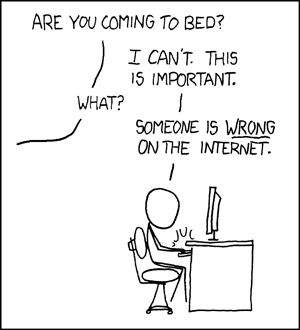
Duty Calls

Caption: What do you want me to do? LEAVE? Then they'll keep being wrong!


The bad thing about Internet is, if you are an assertive person, you will soon find yourself hooked in the abundance of discussions and debates out there. You spend endless hours trying to prove your point to friends and strangers alike.

And you don't even know what you stand to gain from doing so. Sense of satisfaction? Assertion of intellectual superiority and maturity? Or as this comic succinctly points out, the "duty calls"?

I am one of them. And I need to learn more self control. 共勉之.


p/s: Do visit xkcd.com for many other great comics. The best comics out there for geeks.

7 comments:

Wednesday, February 20, 2008

Photography - A Journey

DSC03611 (by changyang1230)I have never been artistic. I have no idea how to colour properly, I do not appreciate art galleries, and I barely pass my arts exam in school every time. In fact I dreaded arts exams in secondary schools, because they tend to lower my average result by a significant amount. Not helping is seeing numbers like 60 on my result slip while others revel in scores like 80 or 95.

So, if you asked me six years ago whether I would pick up photography as a hobby, I would reply you with a loud guffaw, and "siao ah you?". Photography is an art, and art is never my cup of tea.

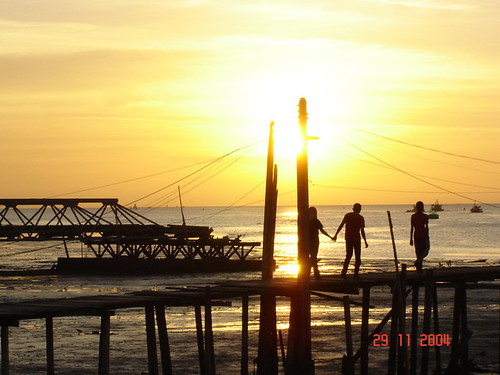
Alor Star Trip 070 (by changyang1230)
Kuala Kedah, taken with Xuan Ni's Sony DSC-P73.


As you can see, I am in love with photography today. Just how did that happen?

The story began when I got my first digital camera at the dawn of its popularity in Malaysia, back in 2003. Before the purchase, I did a thorough research on various cameras as it's a rather costly item. The amount of praises on Canon A70 greatly impressed me, so I ended up with one at the cost of about RM1500. (Today, similar but better cameras e.g. Powershot A560 cost about RM500) The main attraction of that camera was that while designed as a compact camera, it comes with various manual controls which paves the way for learning photography.

The articles I read during the research and the pictures I saw totally mesmerised me. I was intoxicated with such thoughts as "wow this is what I might be able to achieve!". It was so uplifting - the thoughts that I can also create art - it became the defining moment of my love for photography.

DSC08263 (by changyang1230)
Near Cape Jervis, South Australia. Taken with Xuan Ni's Sony DSC-P73.


My Canon Powershot A70 served me well for two years in Shah Alam and one year in Melbourne, before giving way finally to wear and tear (and falls). Throughout the three years of its honourable life, it took thousands of shots for me. Although not all pictures are good, the experience imparted me lots of knowledge about the technical and artistic aspects of photography. I learned to use manual controls like ISO, shutter speed, aperture, white balance etc; and with the great guidance from the legendary Cheok Quen, I was acquainted to the basic operations of Photoshop. My interest in photography grew over time - I often end up in photography section whenever I visit a bookstore, and I engross myself in everything from Digital Photography for Dummies to Photoshop Bible.

I make no claim of myself being a good photographer; but I am confident to say that after years of practice and theories, I am starting to take above-average pictures. In year 2006 I was attracted by the newly established "Fotoholics" which was a new photography club in Melbourne University. Eager to improve my photography skills and know more people, I joined the club. The experience turned out to be eye-opening. I witnessed how ordinary people like you and I are able to produce stunning pictures we see in magazines. Equally memorable is the amount of money some people can spend on the equipments. :P

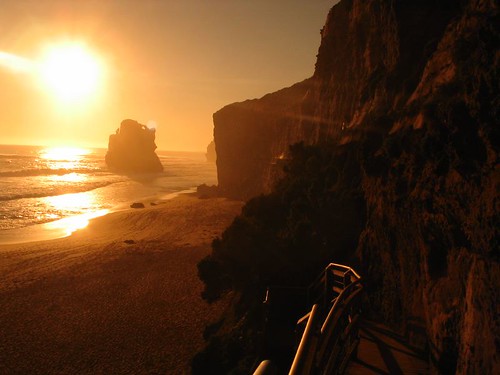
IMG_8282 (by changyang1230)
Gibson's steps overlooking the Twelve Apostles, one of the greatest attractions along Great Ocean Road, Australia.


Over the last year, I became increasingly involved in Fotoholics activity. I helped organising a "photography workshop" where I actually gave one of the lectures about the basics of photography i.e. shutter speed, aperture and ISO. I am also currently responsible for the Fotoholics website. Besides, I participated in various outings and activities in the club.

After almost two years of going without my own camera, I decided to get a decent digital SLR. For the uninitiated, a digital SLR is a category of camera which you would usually refer to as the "pro" or "big" camera. I know that it costs quite a bit, so I started saving up for it through tutoring in Melbourne. After almost one year of sporadic tutoring sessions, I finally earned enough to pay for a decent "starter's package", and that's how I ended up with my EOS 400D.

A digital SLR doesn't automatically transform a bad photographer to a seasoned photojournalist. The photographer matters more than the camera - the most expensive DSLR in an inexperienced hand will produce a picture worst than a cheap compact in a good photographer. However, this is not to undermine the capability of DSLRs (why would I have bought it if it doesn't matter at all). A DSLR enables control over every single aspect of photography. When you master the control of a DSLR, you pretty much tell the camera to produce the picture as you have in mind; instead of clicking the shutter and wishing that the camera somehow gets the brightness, sharpness, colour etc right.

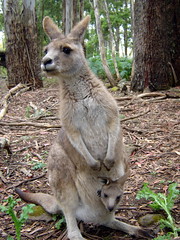
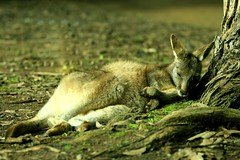
One of the aspects I liked about DSLR is bokeh, the "out of focus blur" effect. Consider these two pictures of Kangaroo in Tasmania (click to view larger version):
DSC09927a (by changyang1230) Sleeping Kangaroo (by fotograz)

The first picture is by myself using compact, second picture by a fellow Fotoholics with SLR.

The first thing you notice is probably the colour, but that isn't really related to the camera as colours can be easily manipulated with Photoshop. But look at the larger version, and notice the background - the compact version has a sharp, distracting background; the SLR version has a blurred, smooth, aesthetically pleasing background. That kind of bokeh is not achievable with a compact - and when I took the picture, I was like, "if only I have an SLR". There are also other aspects like the sharpness which would have been more controllable and hence better if I took it with SLR.

Enough with grandmother stories. So yeah, now with my new camera, I look forward to more exciting journey in photography in the future. If you are interested, do take a peek at my photos at my Flickr album. Comments and criticism are much appreciated.

2 comments:

Monday, January 21, 2008

Home

A year has gone by
While another sojourn ends
I'm back in heaven

4 comments:

Sunday, December 30, 2007

二十二岁的感言


[Click play button for the music]


几天前璇倪为我搞了一个惊喜生日会,吹生日蛋糕前人家叫我说生日感言。我愣在那儿,不懂该说什么好,只会说谢谢、谢谢,谢谢大家今晚来这里为我庆祝生日。说完了大家也就忙着吃东西了,也不懂是不是每个人都听到。

其实我何尝没有感想呢? 有谁生日只是吃喝玩乐;一点回顾、检讨、展望都没有呢?

我不是一个交际广阔的人,平日没多少喧哗亮丽的生活。我所谓的社交,也只是偶尔和三五好友玩玩、吃吃、看看。 我不像许多人随便走在路上都会遇到好几个好朋友,或是每天都有不同的朋友出去玩乐。有时也会羡慕那些知交满天下的人,看起来生活特别有趣的。可是平淡的生活,也有淡淡的甘甜味,忙碌之中能和身边的人一起走过在异乡的日子,我默默感恩。朋友们平日的互相体谅、迁就和提点,我深深感谢。这平静的生日,我不奢望物质上的礼物;一声问候,知道大家都好,那就是最好的礼物。

一年三百六十五天里,生日也不过是又一个平凡的一天。如果我们换个角度想,生日其实是母亲多年前临产艰辛的时刻,而这一天,自然是感恩的日子。我不时常和家人通话,通常也只是通过妈妈知道家里的近况。大家还是一样咬紧牙根过日子,而我也知道哥哥和姐姐们一天比一天忙碌。看到网上放了几张家里新铺的草地,还有那新建好的厨房,感觉上离家也近了一些。不在家的日子,生活上下为自己打算,日子其实还不算辛苦,只是和家里的舒适差得多了。我要感谢家人对我的关怀,这些年来没有你们也不会有今天的我。如果生日有个愿望可以实现,我希望家人都开开心心,健健康康。这愿望听来老套,但我相信这些都是最重要的事情。

璇倪,这是我们第三次一起庆祝我的生日了。你对我说我们总是没机会一起迎接生日的凌晨,有些遗憾。你也总是为了生日要为我制造惊喜、选礼物,费尽心思去筹划,让你在生日前的日子都过得好像有压力似的。我每次告诉你我不要什么特别礼物,那都是真心话。我们没做过什么轰轰烈烈的大事,但是对我来说,每一天能够牵着你的手,看你享受我买的巧克力的模样,那就是我最大的幸福,也就是我最大的礼物。你为我做过的每一件事,我会在每一天以一颗真心来回报。每一年的生日,有你,有我,那多好。

不知不觉中,我已经二十二岁了。 :)

10 comments:

Thursday, October 11, 2007

A Special Patient (1)

I had a special patient today. Let's call her Maria.

Maria is a 21-year-old lady who's coming in Royal Melbourne Hospital for an operation called "Lumbar Discectomy". Basically, it means that she's fixing a disc which had slipped out of its usual position between two bones which are located at her lower back. The displaced disc (see figure - the blue thing labelled L5) impinged on her nerves, and has produced pain on both legs, and it's especially worse in the right leg where it expands throughout the whole length. The pain of this nature is usually referred to as sciatica, as it's usually associated with problem with the sciatic nerve (the fat nerve going down the leg in the figure).

Guess what: Maria has had this problem since she was 12.

Maria's predicament remained undiagnosed because it's rare for young people to get sciatica, which is quite common among older population. Throughout the years, doctors had been telling her that the pain was due to muscular problems, and that it would become better with time. It was not until last year when she couldn't bear with the pain anymore, that she asked for another check-up and discovered this problem. Turned out that she had a really severe case of disc prolapse, and if it's not fixed urgently it would progress to a medical emergency called cauda equina syndrome.

So I had a look at Maria because she was suitable for my study. From her history, I discovered a couple of interesting things:

  • She had been smoking cigarette since 12 year old.
  • She smokes marijuana (weed, 大麻) everyday
If you tell one of the more conservative parents only these information, my bet is that they are going to flinch right there and then while the image of a samseng girl is conjured in their mind. To be honest, I had a bit of hesitation too - is she going to be that kind of violent, uncivilized people?

I mustered my courage to approach her for my study. I stood there and called her name out loud in the waiting lounge, and the girl with her mum and her partner stood up and came to me cheerfully.

I thought:

Shit, they thought I am going to call her in for surgery preparation while I am only inviting them to participate in the research. Damn damn damn. They are going to be so mad at me. She's hungry (patients need to fast a long time before their operation) and impatient and all, and now I am going to invite her to be some sort of research participant. I am so dead.

So I showed them to the interview area, my heart pounding real hard as the family remained cheerful.


[To be continued...]
[19/10/07: Continued here]

6 comments:

Thursday, August 30, 2007

A Golden Jubilee

Post moved to my other blog.

9 comments:

Sunday, August 19, 2007

Earlier than Expected

72453_9820From the day I chose medicine as a career, I have always known that the road ahead would be challenging. Long working hours, stressful environment, distressing tragedies are just a few examples in the long list of adversities faced by healthcare workers. Certainly most people would reap the reward at the end of the day, but concealed from the pride and glory is the sweat and tears as they grudgingly put up a positive front to their colleagues and patients on every single day.

Don't get me wrong here - I am not saying that being a doctor is a bad job. In fact I have been exaggerating the hardship here for the sake of drama. For the past few weeks, watching surgeries, appreciating the marvel of technologies, learning new stuff, talking to doctors, seeing real alive patients (yes you hear it right) have been some of the most rewarding moments since I entered medical school. At the end of each day, Xuan Ni and I usually exchange our daily experiences and stories while walking home along Grattan Street, and that have been been thoroughly enjoyable. We commiserated with the unfortunate cancer patients, tipped off each other about cute doctors, and assuaged each other's complaints as we shuffled home tiredly. And that, I must say, is the highlight of my days.

But still, everything came earlier than expected.

I knew that the future that awaits me are the 36-hour shifts, endless walking in the hospital and breathing in medicine-scented air. But I never knew that busy days have begun to take its toll on me, and such schedules will probably remain until I retire in the unforeseeable future.

I knew that at some point in my life, I will no longer have the freedom of surfing online until the wee hours in the morning - but I didn't know that in order to wake up at 7 everyday, I have already been robbed of that freedom in the third year of medicine.

I knew that I have been living an obscenely slack lifestyle throughout the years, and that it ought to be substituted by the harsh medicinal lifestyle. But I didn't know how a research student's lifestyle could be so much more demanding than the lifestyle of a pre-clinical medical student.

Probably I never knew well enough.

I never knew how lazy I have been for the past 21 years, that even a mildly disciplined lifestyle seems like a punishment to me.

I never empathized enough when my architecture friends complain about sleep-deprivation. Until I begin to sleep less than six hours everyday.

I never knew I am not as adaptable as I thought. When it arrived earlier than expected, I flounder. But I will move on toughly. The only way to go through a hardship, is to move on.

5 comments:

Saturday, June 23, 2007

The Old "My Little Moments"

I started this blog since 2003, and this blog has been my "cyberspace home", an icon of my online presence. But if you think that my cyberspace existence only began since 2003, you are wrong.


Back in 2000, Eric and I were in a craze of making "personal homepages". In that era the word "blog" was still rather unheard of in human civilisation, let alone in the rustic town of Alor Star. In 2000, personal home page was the in thing. I was in Form 3, still chubby and bouncy, and out of narcissism I decided to make myself known in the inter-web. I borrowed a HTML textbook from Chyuan Wei, and I learnt all the HTML tags like <a>, <i>, <u>, <table> etc from scratch. Then, I wrote the whole home page in Geocities using notepad and created the graphics with some free softwares which I have already forgotten. After one to two weeks, the result was what you see in the homepage.

After successfully creating the fancy homepage, somehow I managed to abandon the whole project. The whole homepage degenerated to a faint memory of my bygone enthusiasm. After a few years, I even managed to forget the password to the whole account. It has been 7 years since I last updated the page, and I seldom mention the existence of this homepage to my friends. For some reasons, Geocities has been such a great site that it preserved my site all the while, despite me not maintaining it for seven years. Eric's old homepage, on the other hand, has unfortunately succumbed to the closure of the hosting company, an event which is not terribly rare in the Internet industry.

So you are in luck. Have a good look at Chang Yang's® Personal Homepage. Meanwhile I will forgive you for laughing at my deplorable language. ;)


Thanks to Heng Liang, I am reminded of my old homepage today. After some password-recovery processes, I managed to obtain a new password and now I am a happy owner of the said Geocities account again! Haha I don't know, I might update this site when I am in mood in the future.

5 comments:

Thursday, June 21, 2007

My Little Moments

I realized that for some reasons my blog has not really been "My Little Moments". Rather, it's become more of "the cool stuff I discovered today in Digg / ReCom / other daily Internet fixes" . But I can't resist the temptation.

I should either change the title or change the content. Perhaps more of the latter.

5 comments:

Monday, June 11, 2007

The End

I have an itchy rash. It's on my dick.
- A random patient
They say one the most ecstatic moments a student could have is right when he finishes an exam. Throughout the years I couldn't testify much to that statement. Yes, during exam preparation I do feel the pain for being stranded at home and cramming in the humongous facts, but when the exams are over, I don't really feel "the greatest joy overwhelming me". Relief, yes; but ecstasy, not really. This time, however, I was beginning to feel a little bit of joy when it all ended.

The exams I just had are not so different from the previous four I had throughout two and a half years in Melbourne Uni's medical course. Hard they are as usual, and I still complain about lots of the questions. But somehow, this time I don't really feel good about my whole performance. Everything went awry since the very first day.


Day 1 - Jun 5 - Defense Mechanism and its Failure (Paper 1)

The subject we are having this semester is basically a combination of three topics - microbiology, immunology, and oncology. For this paper, we are having 100 multiple-choice questions which will translate to 30 marks out of 100 of the whole subject.

The paper felt quite strange to me. When I have most of my exams, I either feel one of two things: confident if the questions are rather do-able, or totally flabbergasted if the questions are nonsensical. But this time I got really, really confused. Some questions were downright evil as usual, especially for the pathology sections; but some questions were supposed to be easy but my drained spirit somehow decided that those questions were something out of my grasp.

At the end of two hours, I felt quite dazed. It's one of the hardest MCQ paper I have ever had, but I guess in medicine you eventually get used to getting double digit wrong answers.


Day 2 - Jun 6 - Health Practice 5

This is one of the most random papers you could imagine. It's hard to describe what this subject actually is, but I think I would just summarize it as "the hodgepodge of all non-scientific medical stuff that they think you ought to learn". That includes medico-legal issues, medical ethics, social aspects of healthcare, and doctor-patient interview. For this particular paper, we have 50 multiple choice questions and three short essays, and the whole paper would determine 50 percent of the subject.

I am not sure, but apparently all our Health Practice lecturers have some morbid fetish of seeing students agonizing over meaningless questions. Continuing the tradition from last year's paper, this year the coordinators decided to put in some more rote-memory questions. For example, one question was like this:
What is the one-month prevalence of medical depression in patients with chronic illness?

a) some random percentage
b) another random percentage
c) the third random percentage
d) a last random percentage


I was like, what the hell, are we supposed to be better students if we could memorize those figures? The worse thing is, the answer to this is not even found in the lecture notes, which are supposed to be the sole source for exam questions. Apparently this fact is hidden somewhere in one of the dozens of reading we are supposed to do to supplement the lectures.

Just try to imagine having 5 such questions, among many other impossible questions. But oh well, nobody cares about HP anyway.


Day 3 - Jun 7 - OSCE

OSCE stands for Objective Structured Clinical Examination, or to put simply, patient interviews and physical examinations.

You know what? I. Screwed. It. Up.

OSCE has always been my most dreaded aspect in medicine course. Somehow I always feel nervous about OSCE, although it usually turned out fine for me (except for the first semester). For this semester, we have a random exam chosen from various kinds of examinations we learnt throughout the last two and a half years - breast exam, abdominal exam, chest exam, hip exam, knee exam, lower limb neurological exam, eye exam or ear exam. Besides, there is a component of patient interview where we are supposed to interview a patient who presents with a medical and/or social issue.

The physical exam was alright, it was a heart exam and a blood pressure taking test. I think I did quite well in it, although I wasn't so confident for the blood pressure reading.

On the other hand, the interview was a tragedy. I actually was the first candidates in the morning when I entered the interview room. My patient greeted me joyously, and after some routine greeting procedures like "Hi my name is XX, I am third year medical student blah blah blah", he told me his problem:
I have an itchy rash. It's on my dick.
Upon hearing the word "rash", my mind kind of flipped on the "allergy history" mode and switched all the others. When I say "mode", I mean one of the major presenting problems we learnt in the past including chest pain, breathing difficulty, diarrhoea etc. For each of those problems, there are some specific questions we should ask in order to get a complete history from the patient.

So yeah, I flipped to allergy mode, and that was the point of no return.

I proceeded the whole interview with mainly allergy-related questions, things like family history, personal history of allergies, any exposure to allergens, visit to animal farms or recent travelling etc. And I actually finished on time and felt rather good about it. In the last minute or so, when I finished the whole interview, I sat there smiling with the patient, feeling happy that I nailed down this case.

The moment of truth came when everyone started discussing the case when they finish their own interviews. Someone came and ask me, "So how much sexual history did you get from your patient?". And I was like "Oh ouhh... " I was overwhelmed by shock. How could I have forgotten about sexual history, when his problem was on his groin area?! Sexual history was like a major part of interview for any genital-related problem, and guess just how many marks I have lost when I was smiling like a fool to my "patient"?

I got rather angry at myself. If you ask me how I felt, it's more of disappointment on myself than unhappiness over the screwed-up interview - the interview is not a hurdle requirement anyway. I tend to view myself as a person who is good at improvising and not stuck in a narrow mindset, but I just made a fool of myself in this interview. I got so engrossed in following the scheme of "allergy mode", so much so that I totally ignored the sexual nature of his problem. And to think that the patient actually said "One of my friends have the same rash", to which I enquired "Do you think you might have gotten the rash from your friend" and he replied "Yea probably."

It's a hard blow on me. It's not the mark, it doesn't matter; it's more about how good a doctor I could be if I am not conscious enough about the communication process which entails keen insight and good observation. Sigh. I need to improve.


Day 4 - Jun 8 - Defense Mechanism and its Failure (Paper 2)

For the last day, we have a 3-hour paper consisting of entirely short-answer questions and essays. This is usually the most dreaded paper by most because all the answers come from your head. If you missed one topic and if it comes up, you are in big trouble.

For this time, however, it wasn't quite hard. In fact it was the best day I had throughout the exam, as I felt rather comfortable answering the majority of questions. Although there are still many things that I was unsure about in the exam, at least it's much better than the three previous days' experience.


At the end of paper, I felt that an invisible burden taken off my shoulder. In fact I felt a little bit happy. This exam is certainly not among the best I had, but it's just scores, I tell myself. I am most concerned about the real aspect of being a doctor, and hopefully I will learn more when I go on to my research year in July, and the coming clinical years.

It's the end of my exams, the fifth semester, the lectures, and probably the campus uni life. But I wish that it's not the end of the bond established between us throughout the years.


Related posts:
Jian Wey - Post-exam Reflection
Ka Lip - Day 1, Day 3

4 comments:

Tuesday, May 22, 2007

A Reflection - Melbourne and Its People

Reflection is never my piece of cake, so no, I am not going to write a reflection here. Instead, I would just like to direct you to a blog article I have just read, written by a Melburnian, on Melbourne and its people, in particular the immigrants.

A Few Hundred Meters - The Duality of Man

I have seen both people he described in the story, and reading his reflection conjures up the vision of walking on the streets by myself. It is a good perspective on Melbourne.

0 comments:

Wednesday, May 16, 2007

How Do You Stop an Addiction?

I have an addiction.

I need to stop homing in computers wherever I go, library, my house, Xuan Ni's house, computer lab, tutorial rooms.

I need to stop frequenting websites which has nothing to do with my studies. I check my Google Reader (An RSS reader) wherever I go so that I can see whether there are updates from my friends blogs, Digg (an "interesting news" website), Lifehacker (tech-related tips and tricks), Good Maths Bad Maths (to keep me mathematically literate), Pharyngula (biological stuff) and so on.

I learn stuff like how the Church of Scientology creepily prey on BBC reporters and look stupid in front of cameras, how a mirror would look like when you scan it with a scanner (it's surprising), how Carlton (the place I live in) used to have a train station, and how some states in US are against the law that makes HPV vaccine mandatory for young girls. Oh well, the last one might be slightly related to me, but then it's not going to be in the exams.

At the same time, I am not doing that much of work on this week's topic, acute lymphoblastic leukemia, and also leukemia and lymphoma in general. Every night I tell myself "I'm going to start studying at 9", but I end up doing all sorts of stuff online and study for only half an hour before going to bed.

I visit ReCom to read and "patrol" the discussions because I am one of the moderators of the forum. When I got tired of the immature comments, I spend hours typing retorts and warning members when they go overboard. After three years of involvement there, to date my post count is 1836.

All that, and my exams are three weeks away. I should at least cut down Digg and ReCom in my daily addiction fix. They are killing my time, and probably my score too. Wish me good luck.


p/s: By the way, all the stuff I linked to above are strongly recommended websites and articles. If you think that the Internet is a boring place, have a look at those websites and you might have a second thought. :)

6 comments:

Tuesday, March 06, 2007

The Irony of Immunology

The irony struck home when I was staying up in the midnight to read this line in an article called "adaptive immune system":

The immune system is enhanced by sleep and rest, and is impaired by stress.
I should sleep. Good night.

3 comments: