[Video] If the Earth Has Rings Like Saturn's
Do want!
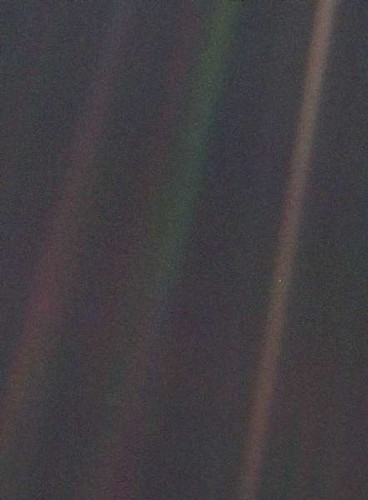
I have blogged about it before, but I don't think a good thing can ever be shared more than it should be. Behold the Pale Blue Dot, one of the most famous astronomy pictures of all time.
From this distant vantage point, the Earth might not seem like any particular interest. But for us, it's different. Consider that little dot. That's here. That's home. That's us. On it, everyone you loved, everyone you know, everyone you ever heard of, every human being who ever was, lived out their lives. The aggregate of our joys and sufferings, thousands of confident religions, ideologies and economic doctrines, every hunter and forager, every hero and coward, every creator and destroyer of civilizations, every king and peasant, every young couple in love, every mother and father, hopeful child, inventor and explorer, every teacher of morals, every corrupt politician, every superstar, every supreme leader, every saint and sinner in the history of our species, lived there on a mote of dust, suspended in a sunbeam.
The Earth is a very small stage in a vast cosmic arena. Think of the rivers of blood spilled by all those generals and emperors so that in glory and triumph they could become the momentary masters of a fraction of a dot. Think of the endless cruelties visited by the inhabitants of one corner of this pixel on the scarcely distinguishable inhabitants of some other corner. How frequent their misunderstandings, how eager they are to kill one another, how fervent their hatreds. Our posturings, our imagined self-importance, the delusion that we have some privileged position in the universe, are challenged by this point of pale light.
Our planet is a lonely speck in the great enveloping cosmic dark. In our obscurity, in all this vastness, there's no hint that help could come from elsewhere to save us from ourselves. The Earth is the only world so far to harbour life. There is nowhere else, at least in the near future, to which our species could migrate. Visit, yes; settle, not yet. Like it or not, for the moment, the Earth is where we make our stand. It has been said that astronomy is a humbling and character-building experience. There is perhaps no better demonstration of the folly of human conceits than this distant image of our tiny world. To me, it underscores our responsibility to deal more kindly with one another and to preserve and cherish the pale blue dot, the only home we've ever known.
Have you seen this video by Discovery Channel? It's so catchy and uplifting.
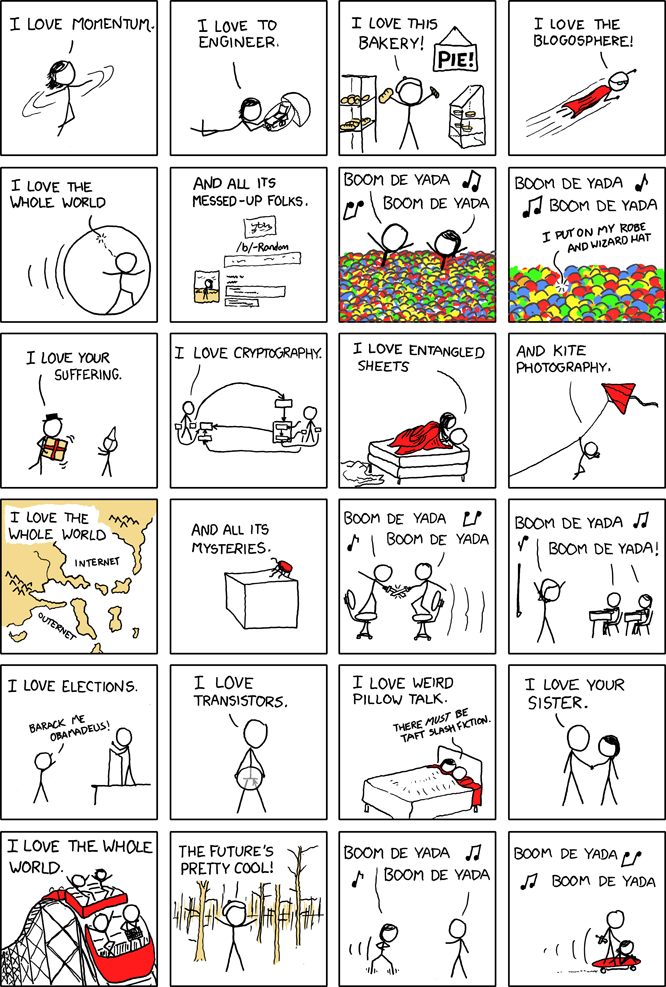
I love the mountainsAnd you have this XKCD comic: (what introduced me to the video above)
I love the clear blue skies
I love big bridges
I love when great whites fly
I love the whole world and all its sights and sounds
Boom de yada
Boom de yada
Boom de yada
Boom de yada
I love the ocean
I love real dirty things
I love to go fast
I love Egyptian kings
I love the whole world and all its craziness
Boom de yada
Boom de yada
Boom de yada
Boom de yada
I love tornados
I love arachnids
I love hot magma
I love the giant squids
I love the whole world, its such a brilliant place
Boom de yada
Boom de yada
Boom de yada
Boom de yada
When my housemates and I were having dinner yesterday night, someone brought out some interesting questions:
I have always loved to use the word "perspective" in my writing, but I could never have done this word as much justice as this page:
Universcale
Two years ago, I wrote this post on the joyous day of my homecoming. Not many people realised what it meant.
The answer is: they are the antipodes of my travel origin and destination.
In other words, if I digg a hole straight down from Melbourne and go through the whole Earth's interior, I will come out in the middle of the Atlantic Ocean. If If I digg a hole from Malaysia, it will come out some where in Ecuador, South America!
Try to find out where your favourite location's antipode is: Link. If you stay in US, don't bother: you are going to drink salt water in Indian Ocean. The next time your kid ask you "what's at the other end of the Earth", don't tell them it's China.
Note: This is part of my effort to clear up my "unfinished posts".
I was reading on Global Warming when I noticed the classical Chinese version of the article (Yes they do have classical Chinese version of Wikipedia!).
全球暖化者,天地日暖也。蓋百年以來,其勢日明,其害日顯,此固由人為也。工業日進,污染日甚,溫室氣體日濃,熱無以去,遂俳佪於天地間。萬物因而易,異象因而生。海面日漲、氣候突變、水旱交侵,致使農業廢失、物種亡絕、病蟲日增。萬民見害,苦之久矣。諸國遂盟,訂《京都議定書》,力減溫室氣體之釋,以緩此變。惟其成功與否,尚未可知。这段落读起来好像是古代历史,不像是现代环境危机哦!
I have a new favourite quote. It's from Richard Feynman, the maverick physicist.
There are 10^11 stars in the galaxy. That used to be a huge number. But it's only a hundred billion. It's less than the [US] national deficit! We used to call them astronomical numbers. Now we should call them economical numbers.I have been going out a lot recently, so this is just a filler for the blog while I am recovering from fatigue. :)
This post is a continuation of an earlier post.
Space isn't remote at all. It's only an hour's drive away if your car could go straight upwards.So somehow, people always use the term "zero gravity" to describe space as though it somehow escaped Earth's gravitational pull and is effectively receiving no attraction from the gigantic rock at all. You see terms like "there's no gravity in space" all over the place, spoken even by the astronauts themselves.Fred Hoyle
Half of all astronauts suffer space motion sickness when they encounter microgravity and feel as if they are falling. This affects our neurovestibular system, which is what helps our body keep proper orientation while on Earth. This feeling is not dissimilar to the sensation felt after you have been on a terrifying roller-coaster ride. It simply means that your body doesn’t know which way is up, down, left or right.This paragraph is misleading.
Everyone knows that the gravity in outer space is zero. Everyone is wrong.So there we have it: Astronauts are not floating in zero gravity, they are constantly falling under the gravitational force. They feel just like a bungee jumper, a skydiver, or a person in a roller coaster going down a gigantic drop.
Gravity in space is not zero, it can actually be fairly strong. Suppose you climbed to the top of a ladder that's about 300 miles tall. You would be up in the vacuum of space, but you would not be weightless at all. You'd only weigh about fifteen percent less than you do on the ground. While 300 miles out in space, a 115lb person would weigh about 100lb. Yet a spacecraft can orbit 'weightlessly' at the height of your ladder! While you're up there, you might see the Space Shuttle zip right by you. The people inside it would seem as weightless as always. Yet on your tall ladder, you'd feel nearly normal weight. What's going on?
The reason that the shuttle astronauts act weightless is that they're inside a container which is FALLING! If the shuttle were to sit unmoving on top of your ladder (it's a strong ladder,) the shuttle would no longer be falling, and its occupants would feel nearly normal weight. And if you were to leap from your ladder, you would feel just as weightless as an astronaut (at least you'd feel weightless until you hit the ground!)
So, if the orbiting shuttle is really falling, why doesn't it hit the earth? It's because the shuttle is not only falling down, it is moving very fast sideways as it falls, so it falls in a curve. It moves so fast that the curved path of its fall is the same as the curve of the earth, so the Shuttle falls and falls and never comes down. Gravity strongly affects the astronauts in a spacecraft: the Earth is strongly pulling on them so they fall towards it. But they are moving sideways so fast that they continually miss the Earth. This process is called "orbiting," and the proper word for the seeming lack of gravity is called "Free Fall." You shouldn't say that astronauts are "weightless," because if you do, then anyone and anything that is falling would also be "weightless." When you jump out of an airplane, do you become weightless? And if you drop a book, does gravity stop affecting it; should you say it becomes weightless? If so, then why does it fall? If "weight" is the force which pulls objects towards the Earth, then this force is still there even when objects fall.
So, to experience GENUINE free fall just like the astronauts, simply jump into the air! Better yet, jump off a diving board at the pool, or bounce on a trampoline, or go skydiving. Bungee-jumpers know what the astronauts experience.
 The concept of "zero-gravity" and freefall should be explained with the diagram on the right.
Warning: The following is going to be a nerdy rumbling. If you have no interest in physics, space, gravity or whatsoever, you should avoid this article so that you don't fall asleep and wake up blaming me for it. :)
I have a peeve about the term "zero gravity".
In the flurry of space tourism news in recent weeks, the term "zero gravity", or "microgravity" cropped out like m-u-s-h-r-o-o-m-s after a monsoon season. And I am disturbed by the fact that the misleading terms have been taken used so rampantly without further explanation in the media.
To begin with, let's look at a few examples from the news articles:
Living in space is quite different than on Earth. That difference, of course, lies in that trifling matter we call gravity or, rather, the lack of it.
As it left the earth's atmosphere, the rocket achieved zero gravity within the next four minutes and soared into the stratosphere.
All the news articles sound very convincing. After all, as a child, haven't we all seen how astronauts float effortlessly in the outer space when there are no gravity forces, and didn't everyone enthusiastically make "angkasawan" our childhood ambition because of the sheer fun of floating? Everyone knows there is no gravity in the outer space, outside the Earth's atmosphere!When the rocket motors start to roar, our angkasawan will begin to experience an increasing G-force in proportion to the increase in acceleration.
[snip]
This period of high-acceleration will last for 8 to 9 minutes until the rocket ship travels 100km above the Earth and reaches the necessary speed of 18,000mph, sufficient to carry it all the way to the International Space Station (ISS). This will take about 50 minutes after the engines stop firing and during this time, zero-G will prevail and this is when astronauts will experience that sense of weightlessness most people associate with being in space...
[snip]
The good news is that once you arrive onboard the ISS, zero-G is nullified as there will be a “synthetic gravity” produced by spinning the space station around its centre. This is a very necessary factor for the well-being of the astronauts as microgravity exposure alters the human body in many ways.
Half of all astronauts suffer space motion sickness when they encounter microgravity and feel as if they are falling. This affects our neurovestibular system, which is what helps our body keep proper orientation while on Earth. This feeling is not dissimilar to the sensation felt after you have been on a terrifying roller-coaster ride. It simply means that your body doesn’t know which way is up, down, left or right.

Top scientists agree: "With the present rate of human consumption, the earth's supply of gravity will be exhausted before the 24th century."
Unfortunately the world works just like this game. Sometimes we imagine, if everyone obeys traffic rules, the traffic congestion would be dramatically reduced. But people break the rules. If every country in the world destroys their nuclear weapons, this will be a much safer world. But we will never live to see a day with a nuclear-free world. If everyone unites and strive for the greater good, this will be a much better world. But human won't unite. The reason? The same as in this game. As long as there are competitions, there will be "good" and "bad" people who assume their own niches in the equilibrium of the complex net of interactions. Game theory dictates it.
 Game theory is fascinating. Since I first learnt about it some years ago, I have been absolutely enchanted by how it seems to apply to everything in this world - including, but not restricted to animal behaviours (including human's), evolution, cultural revolution, economics, politics, nuclear warfare, global warming treaties etc. The implications of game theory just seem to pop up everywhere.
Do you put your mobile phone on your pocket, and sometimes you feel that it vibrated, but when you pick it up there really wasn't any call or message?
I thought I was the only person who felt it. And I thought it was just some vibration introduced by my pants.
But apparently, many other people thought they were the only one as well. A recent news article in USA Today highlighted this interesting issue and provided an explanation:
Some who experienced recurring phantom vibrations wondered whether the phenomenon had physical roots: Was it caused by nerve damage or muscle memory?A whole new dimension has just been added to the adage "it's all in your mind". Allow me to end this post with my first haiku:
But experts say the false alarms simply demonstrate how easily habits are developed.
Psychologically, the key to deciphering phantom vibrations is "hypothesis-guided search," a theory that describes the selective monitoring of physical sensations, says Jeffrey Janata, director of the behavioral medicine program at University Hospitals in Cleveland. It suggests that when cellphone users are alert to vibrations, they are likely to experience sporadic false alarms, he says.
"You come armed with this template that leads you to be attentive to sensations that represent a cellphone vibrating," Janata says. "And it leads you to over-incorporate non-vibratory sensations and attribute them to the idea that you're receiving a phone call."
Alejandro Lleras, a sensation and perception professor at the University of Illinois at Urbana-Champaign, adds that learning to detect rings and vibrations is part of a perceptual learning process.
"When we learn to respond to a cellphone, we're setting perceptual filters so that we can pick out that (ring or vibration), even under noisy conditions," Lleras says. "As the filter is created, it is imperfect, and false alarms will occur. Random noise is interpreted as a real signal, when in fact, it isn't."
Phantom cellphone vibrations also can be explained by neuroplasticity — the brain's ability to form new connections in response to changes in the environment.
When cellphone users regularly experience sensations, such as vibrating, their brains become wired to those sensations, Janata says.
"Neurological connections that have been used or formed by the sensation of vibrating are easily activated," he says. "They're over-solidified, and similar sensations are incorporated into that template. They become a habit of the brain."
A phone vibration
Hurriedly I picked it up
Alas there's nothing.
Virus and bacteria are absolutely different things. Bacteria are little single-cell critters. Virus is just a genetic component plus a protein "cap", and sometimes a oily envelope. Their structure and function are entirely different. Perhaps the only similarity between them is that they both contain species that could cause disease in humans.
But apparently some of the reporters in Australia can't really tell the difference between virus and bacteria.
Link

Carl Sagan wrote some of the most wonderful short stories, articles and non-fictions I have ever come across. In my brief encounter with some of his works, the "Reflection on a Mote of Dust" from Pale Blue Dot turned out to be the most captivating, and shall I say, humiliating. It puts everything in a universal perspective. The "Bad Astronomy Blog" described it as "the required reading of every human on this planet", and I couldn't quite object to the superlative.
It's something that should be shared with everyone. As a lead, this picture was taken by Voyager 1 in 1990, from more than 6 billion kilometers from Earth. Carl Sagan was so moved by the immensity of this picture that he wrote down the following:
We are always humbled by the observation of the natural world. The sheer scale of astronomy, and the minuscule world of the microbiology are the two extremes of the physical spectrum, but they are both sources of inspiration to us. We always think of ourselves as the most important beings that have ever existed, ignorant of the fact that both the universe and the bacteria could exterminate us in a matter of seconds. How lucky we are to be here at all.We succeeded in taking that picture [from deep space], and, if you look at it, you see a dot. That's here. That's home. That's us. On it, everyone you ever heard of, every human being who ever lived, lived out their lives. The aggregate of all our joys and sufferings, thousands of confident religions, ideologies and economic doctrines, every hunter and forager, every hero and coward, every creator and destroyer of civilizations, every king and peasant, every young couple in love, every hopeful child, every mother and father, every inventor and explorer, every teacher of morals, every corrupt politician, every superstar, every supreme leader, every saint and sinner in the history of our species, lived there on a mote of dust, suspended in a sunbeam.
The earth is a very small stage in a vast cosmic arena. Think of the rivers of blood spilled by all those generals and emperors so that in glory and in triumph they could become the momentary masters of a fraction of a dot. Think of the endless cruelties visited by the inhabitants of one corner of the dot on scarcely distinguishable inhabitants of some other corner of the dot. How frequent their misunderstandings, how eager they are to kill one another, how fervent their hatreds. Our posturings, our imagined self-importance, the delusion that we have some privileged position in the universe, are challenged by this point of pale light.
Our planet is a lonely speck in the great enveloping cosmic dark. In our obscurity -- in all this vastness -- there is no hint that help will come from elsewhere to save us from ourselves. It is up to us. It's been said that astronomy is a humbling, and I might add, a character-building experience. To my mind, there is perhaps no better demonstration of the folly of human conceits than this distant image of our tiny world. To me, it underscores our responsibility to deal more kindly and compassionately with one another and to preserve and cherish that pale blue dot, the only home we've ever known.
I don't like stupid blog-taggings where you are so-called "tagged" and are expected to write "interesting" things about yourself or your friends. It was fun for once or twice, but when you get tagged for more than that, things get a bit stale.
But I admit it. This one looks quite interesting. Shou Farn tagged me this time, and it's a book-tag. It's a tag to write about a book. So here we go:
1) Grab the closest book to you.
Bill Bryson's "A Short History of Nearly Everything"
- When I read the "tag" this afternoon, I was doing the weekly PBL research. Incidentally, the closest book to me was a medical textbook - Robbin's Pathologic Basis of Disease. It is as heavy as your regular bricks and the texts are tinier than the newspaper print. And I don't want to put it here because it's too boring for anyone to appreciate. Hence, the subject is changed to this book which is on my desk at the moment.
2)Open to page 123, go down to the 4th sentence.
3) Post the text of the following 3 sentences on your blog.
Brand became convinced that gold could somehow be distilled from human urine. (The similarity of colour seems to have been a factor in his conclusion.) He assembled fifty buckets of human urine, which he kept for months in his cellar.By the way I strongly recommend this book to everyone.. It's meant to be the history of the universe, but you can easily read this book as the history of science as well. The author was a layman to science before he set out to write this book, and he lamented that all the scientific books and texts out there are too dry to be digested, and it hindered people from appreciating its beauty. So in a moment of epiphany, he decided that science needs not be as dull as he grew up to believe in. And he set out to "re-learn" science by his own effort, and produced this history of science / universe in a series of stories. In his own words: ...
It was as if he [the textbook author] wanted to keep the good stuff secret by making all of it soberly unfathomable. As the years passed, I began to suspect that this was not altogether a private impulse. There seemed to be a mystifying universal conspiracy among textbook authors to make certain the material they dealt with never strayed too near the realm of the mildly interesting and was always at least a long-distance phone call from the frankly interesting.I am only one third through the book, but I find it so well-written and provides a really good introduction to science for science lovers, science haters and science indifferent-ers alike. So if you have some free time, grab a copy from your local library. It's worth your time.
... I now know that there is a happy abundance of science writers who pen the most lucid and thrilling prose ... but, sadly, none of them wrote any textbook I ever used. All mine were written by men (it was always men) who held the interesting notion that everything became clear when expressed as a formula and the amusingly deluded belief that the children of America would appreciate having chapters end with a section of questions they could mull over in their own time. So I grew up convinced that science was supremely dull, but suspecting that it needn't be, and not really thinking about it at all if I could help it...
... [After a moment of epiphany] I decided that I would devote a portion of my life - three years, as it now turns out - to reading books and journals and finding saintly, patient experts prepared to answer a lot of outstandingly dumb questions. The idea was to see if it isn't possible to understand and appreciate - marvel at, enjoy even - the wonder and accomplishments of science at level that isn't too technical or demanding, but isn't entirely superficial either.
That was my idea and my hope, and that is what the book that follows is intended to do.
Is your brain male or female? Find out in this very interesting test that I found through Digg: Link
If you're interested, you can read my result here.


 Posts
All Comments
Posts
All Comments




1 comments:
Post a Comment